Imposex - The chemical that changed the sex of a species (no really)
From the book The Change available for Pre-Order Now on Amazon.
The premise of my novel is that an industrial chemical leaks into a river, meets something ancient living in the water, and the result changes the sex of most of the people who drink it.
I build the science in my fiction the same way every time. If a thing is real, or something close to it is real, I learn how it actually works and I write it true. Then, because this is science fiction, I add the one element that is not true, at least not yet, and I let the impossible part go unexplained.
When I wrote the plan for this novel I was certain the reaction was the invented part. So certain that I did not do the thing I always do, which is go looking for a grain of truth in it first. I was wrong, and I found that out only after the first draft was finished.
Because a chemical released by human industry has already rewritten the sexual anatomy of an entire class of animals, across more than 260 species, on coastlines all over the world.¹ It happened in my lifetime. It has a name. And unless you are a marine biologist you are likely to be as surprised as I was.
The chemical is tributyltin.
If you have ever owned a boat you have either solved this problem or paid someone to solve it for you. Barnacles and weed foul a hull, the hull drags, the fuel bill climbs. So you haul out, you scrape, and you paint on something designed to kill whatever tries to settle. From the late 1960s the best thing anyone had ever found for that job was tributyltin.² It worked beautifully. It also leached into the water.
What it did there is called imposex: the imposition of male sexual organs onto female marine snails.
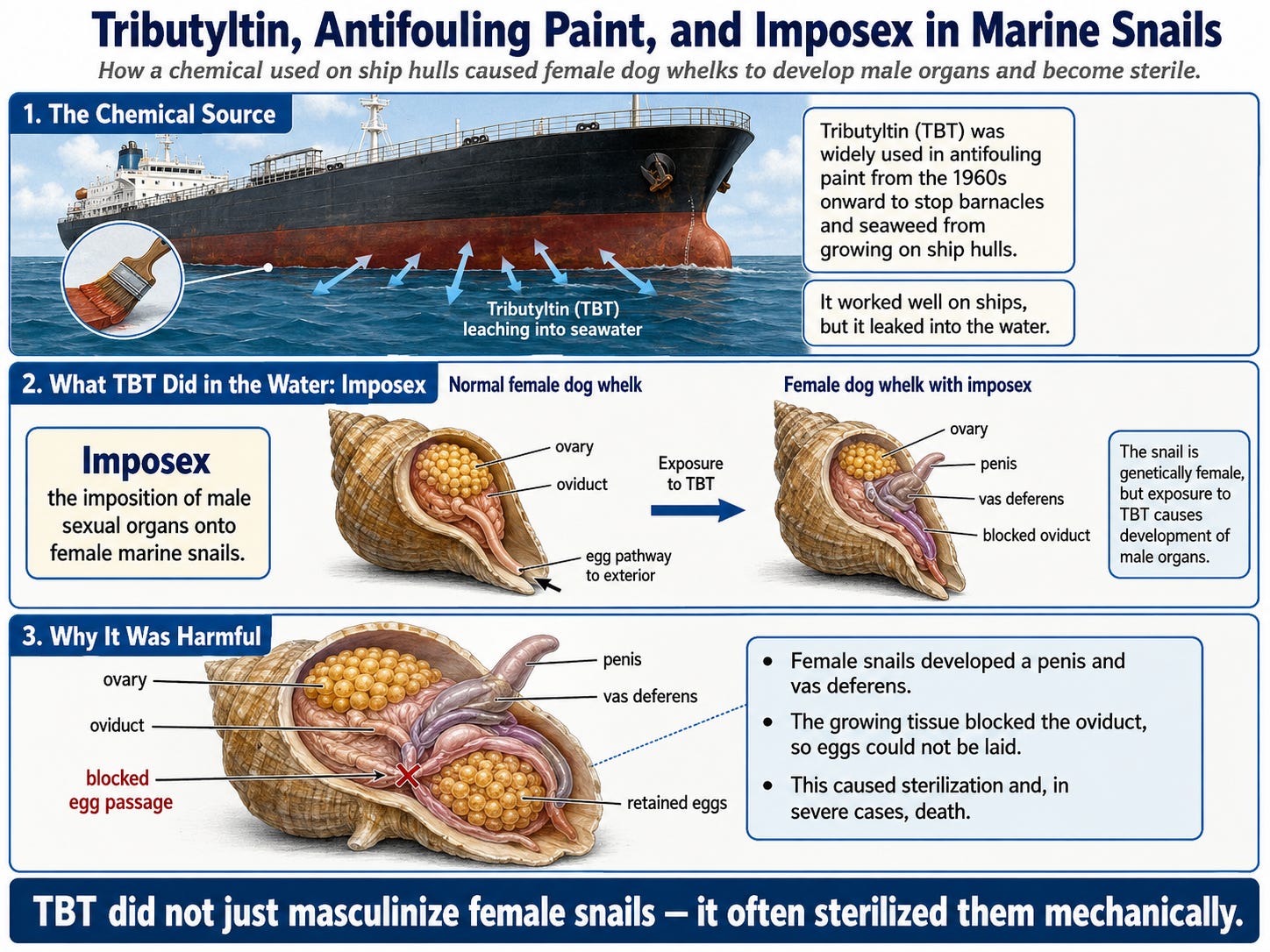
A dog whelk that is genetically female, with a functioning ovary, grows a penis and a vas deferens on top of her own anatomy. And as that tissue proliferates it blocks the oviduct, so she cannot release her eggs. She is not merely masculinized. She is mechanically sterilized, and in the worst cases killed by the eggs she cannot lay.
Now, this is the part that made me put my wine glass down.
Peter Gibbs and colleagues at Plymouth established the dose-response in 1987. Imposex, they wrote, is “initiated by as little as 1 ng/l of tributyltin.”³ That is one nanogram per liter, or one part per trillion. One gram of the stuff, about the weight of a paper clip, is enough to contaminate a million metric tons of seawater to that level.
At 4 parts per trillion about half the females are sterile. Between 7 and 10, breeding in the population stops.³ Meanwhile, summer concentrations in affected British harbors were regularly running above 100.²
Dog whelks did not merely decline in those places. They vanished. Local extinctions were documented along a stretch of shore at Millport, from the Tyne estuary to Marsden Bay, around Lerwick in Shetland, and across sites in the southwest of England.⁴
I want to be precise here, because the temptation to overstate is enormous and the true version is strange enough to be fiction.
Imposex is not a sex change. The snail’s ovary stays an ovary. What she gets is male plumbing built on top of female biology, by a molecule she encountered at a concentration no human sense could detect, like a faint blue hue that is there and then gone. And it is not universal even among gastropods. Some 42 species carry tributyltin without ever developing it, and there is evidence that a few species show something like it naturally.¹
But the vertebrate version is not much gentler. In 1998 Susan Jobling, John Sumpter, Charles Tyler and colleagues sampled fish called roach in English rivers. A roach, for anyone about to picture an insect, is a small silver freshwater fish with red fins, a cousin of the carp, and one of the most widespread freshwater fish in Europe.⁵ Downstream of sewage treatment plants, the proportion of intersex males ran from 16 to 100 percent, against 4 to 18 percent at the control sites. At two of those rivers, every single male fish was intersex.⁶
The cause was not industry. When they modeled it properly, the correlation was with the size of the human population upstream, the estrogens that people excrete passing through treatment plants that were never designed to remove them. They found no correlation at all with the proportion of industrial effluent.⁷ Not a factory. Just us.
So a pollutant can masculinize a female at parts per trillion, and trace hormones in a river can feminize a wild vertebrate population. That was already more than I expected to find.
What I did not expect was the rest.
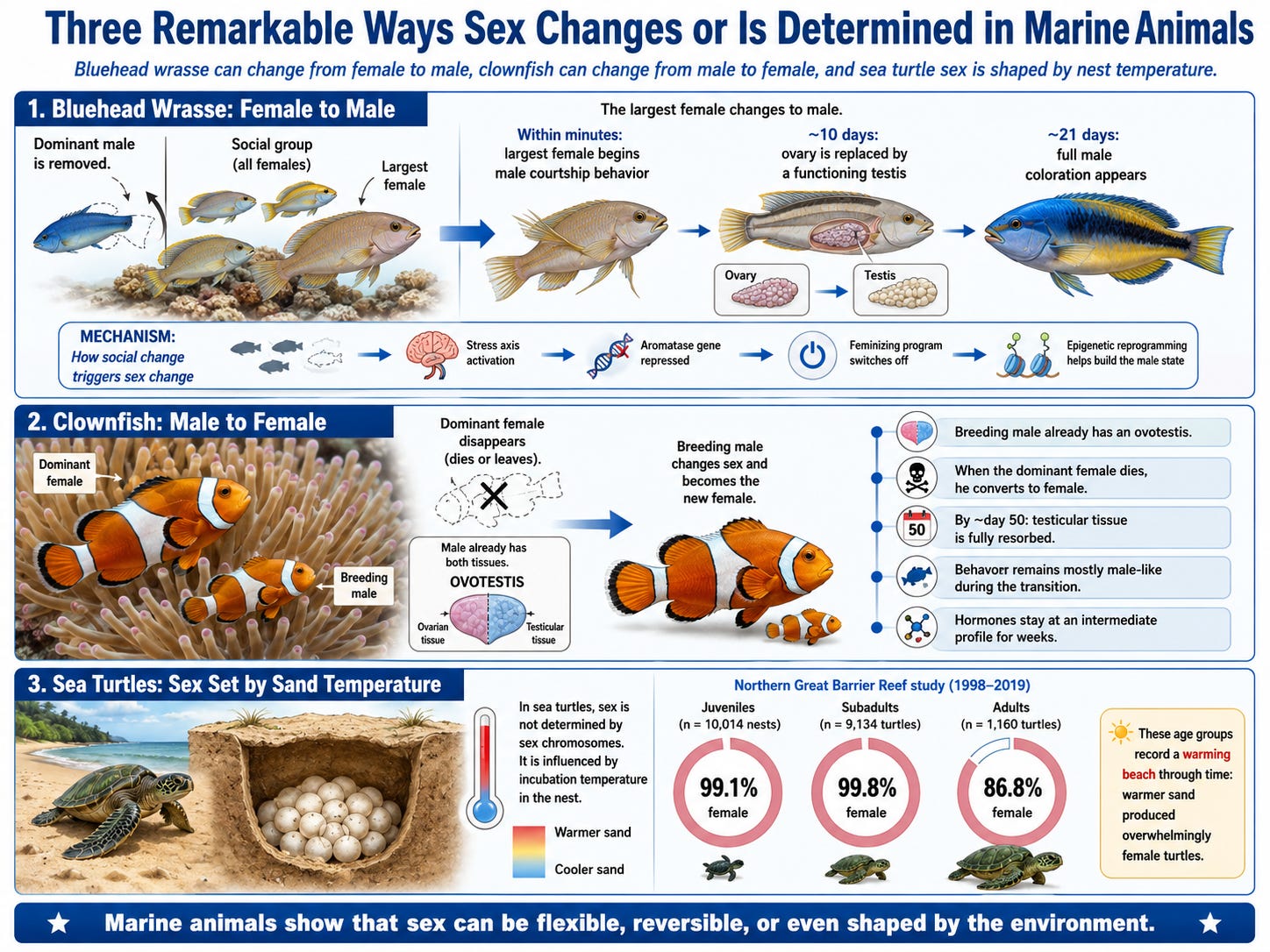
A bluehead wrasse changes sex completely. Remove the dominant male from a group and the largest female begins courting as a male within minutes. Her ovary is dismantled and a functioning testis is built in its place in 8 to 10 days. Full male coloration takes about 20. In 2019 a team led by Erica Todd and Neil Gemmell worked out much of how: the social cue arrives through the stress axis, represses the aromatase gene, and collapses the entire feminizing genetic program, accompanied by wholesale epigenetic reprogramming.⁸
Clownfish do the reverse, slower and stranger. In the Red Sea two-band anemonefish, the breeding male already carries an ovotestis, on average 55 percent ovarian tissue while he is functioning as a male. When the dominant female dies he converts, and his testicular tissue is completely resorbed by day 50.⁹ And in a finding I still think about, a 2022 study of the common clownfish found the animal behaves in a persistently male-like way throughout, with hormones parked at a stable intermediate profile, neither male-typical nor female-typical, for weeks.¹⁰ The transitional animal is not halfway between two things. It is a third thing, and it is stable.
And in sea turtles, one of my favorite creatures on this planet, sex is not written in chromosomes at all. It is set by the temperature of the sand. On the warm northern Great Barrier Reef, a 2018 study found green turtles that were 99.1 percent female among juveniles, 99.8 percent among subadults and 86.8 percent among adult-sized animals.¹¹ Read that in order and you are reading a chronological record of a beach heating up, written into the bodies of the animals standing on it.
Here is what that adds up to, and why I have gone back into the manuscript.
Every component of my invented catastrophe already exists in nature, separately.
An environmental chemical that rewrites adult sexual anatomy at undetectable concentrations. A trace contaminant that feminizes wild vertebrates across whole river systems. Vertebrates whose adult bodies retain the machinery to dismantle one reproductive system and build the other. And species where sex is decided not by chromosomes but by a variable in the surrounding world.
I did not invent the principle. I invented the combination, and one thing more: the vector. Nothing in nature does this to a mammal, and nothing does it contagiously, breath to breath. Adult humans do not change sex, and no chemical yet found makes them. That part remains fiction. Thankfully.
But the distance between what I made up and what is documented is far shorter than I believed when I was writing it. I thought I was building a metaphor. It turns out I was building an extrapolation.
The Change is out on October 1.
References
Titley-O’Neal CP, Munkittrick KR, MacDonald BA. The effects of organotin on female gastropods. J Environ Monit. 2011;13(9):2360–2388. doi:10.1039/c1em10011d. PMID 21826318.
Cefas, Marine Online Assessment Tool: Imposex. https://moat.cefas.co.uk/pressures-from-human-activities/contaminants/imposex/. See also Langston WJ, Pope ND, Davey M, et al. Recovery from TBT pollution in English Channel environments: A problem solved? Mar Pollut Bull. 2015;95(2):551–564. PMID 25733081.
Gibbs PE, Bryan GW, Pascoe PL, Burt GR. The use of the dog-whelk, Nucella lapillus, as an indicator of tributyltin (TBT) contamination. J Mar Biol Assoc UK. 1987;67(3):507–523. doi:10.1017/S0025315400027260. Concentrations in this paper are expressed as TBT-tin.
Birchenough AC, Evans SM, Moss C, Welch R. Re-colonisation and recovery of populations of dogwhelks Nucella lapillus (L.) on shores formerly subject to severe TBT contamination. Mar Pollut Bull. 2002;44(7):652–659. PMID 12222888.
FishBase, Rutilus rutilus. https://www.fishbase.se/summary/rutilus-rutilus.html
Jobling S, Nolan M, Tyler CR, Brighty G, Sumpter JP. Widespread sexual disruption in wild fish. Environ Sci Technol. 1998;32(17):2498–2506. doi:10.1021/es9710870. The 100 percent figure refers to two rivers coded J and M.
Jobling S, Williams R, Johnson A, et al. Predicted exposures to steroid estrogens in U.K. rivers correlate with widespread sexual disruption in wild fish populations. Environ Health Perspect. 2006;114(Suppl 1):32–39. PMID 16818244. 1,438 roach across 45 sites on 39 rivers; no correlation with industrial effluent (r² = 0.013).
Todd EV, Ortega-Recalde O, Liu H, et al. Stress, novel sex genes, and epigenetic reprogramming orchestrate socially controlled sex change. Sci Adv. 2019;5(7):eaaw7006. PMID 31309157.
Casas L, Saborido-Rey F, Ryu T, Michell C, Ravasi T, Irigoien X. Sex change in clownfish: molecular insights from transcriptome analysis. Sci Rep. 2016;6:35461. PMID 27748421. Study species Amphiprion bicinctus.
Parker CG, Lee JS, Histed AR, Craig SE, Rhodes JS. Stable and persistent male-like behavior during male-to-female sex change in the common clownfish Amphiprion ocellaris. Horm Behav. 2022;145:105239. PMID 35926412.
Jensen MP, Allen CD, Eguchi T, et al. Environmental warming and feminization of one of the largest sea turtle populations in the world. Curr Biol. 2018;28(1):154–159.e4. PMID 29316410. Turtles were sampled at foraging grounds and genetically assigned to their natal rookeries.