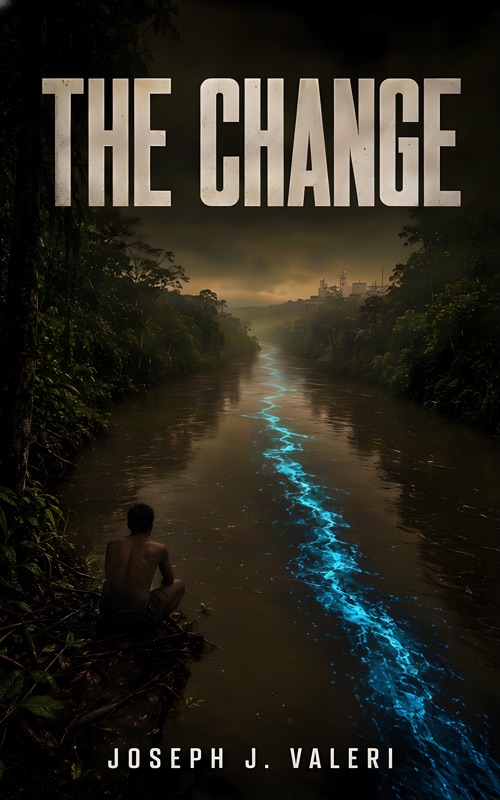
The Change
Anybody can change. One man profits.
It's the 2070s. The seas have taken Florida and the Carolinas, and what used to be the United States is now the Sovereign Nations Pact — an oligarchy that outlawed science a generation ago and burns the "Forsaken" in public squares. On the upper Ucayali in eastern Peru, a 23-year-old tribesman kneels and drinks from the river he has drunk from every day of his life, and this time it tastes of metal. He wakes the next morning Changed: the first case of a pandemic that spreads breath to breath and touch to touch, and leaves anyone past the age of fourteen liable to fall asleep as one gender and wake as the other. No pattern, no warning, no way to wall it out. Two people race toward the cause from opposite ends of the earth — a scientist who means to find the cure and give it away for nothing, and the heir to the fortune that quietly caused it, who doesn't want a cure at all, because a cure pays once and a treatment pays forever. And it does not stay a race. As Elka closes in, the people helping her begin dying in ways that look like bad luck — an immunologist in Panama, an unmarked white truck drifting across the center line and gone before the dust settled. Then the boats come up the Ucayali. Mercenaries with drones and rifles who wear no uniform and answer to no flag, only to the money behind them, and their orders are not to bring back one scientist. The order carried upriver is to empty the valley of the tribe that is the living evidence. They come as an army comes, which is their first mistake, because the forest has its own ways of keeping what it is given. It's told Clarke-style, through the disconnected lives of strangers who never all meet: a senator, an athlete, a cult leader, a scientist, a tribesman. Structurally it's my attempt at Childhood's End. Tonally it's closer to The Power.
Read an excerpt
Chapter One
The Blue Water
Ucayali River Valley, Eastern Peru, May 8, 2070
Neten Pero had drunk from the Ucayali every day of his life, and the river had never once tasted of black stone.
He noticed it on the eighth morning of the rains, half a day east of his village, where the water ran fast and clear over stone worn by time. He had been walking since before light, his throat was dry, and he knelt at the bank the way his father had taught him to kneel, with one hand flat on the earth to thank it. He cupped the water. He raised it. And he stopped with his hands still at his mouth, because the river he had known for twenty-three years did not look like the river in his hands.
It carried a hue. Not the brown of churned silt, not the green of the slow pools downstream. A faint blue, the blue of a bruise under brown skin, there and not there depending on how the light fell upon it. He turned his palms and the color slid across them and was gone. He told himself it was the sky. There was no sky here; there was only the roof of the forest, a hundred feet up, and the gray light coming through it.
He drank anyway. A man does not walk half a day and refuse the river he has drunk from all his life. The taste was wrong in a way he had no word for. Cold and bright and a little sweet, like the inside of a stone. It was not bad. It did not turn his stomach. It was simply not the taste of his river, and Neten knelt there a moment longer, turning it over, the way you turn over a word a stranger has said in your own language, but said slightly wrong.
His people, the Zipibo believed the world spoke to them through nature. The river was not simply water that happened to run downhill. It was the oldest living thing they knew, older than the village, older than the names of the dead, and when it changed like this, it was trying to tell him something. Typically, he would have thought hard on what the river was trying to say, but his mind was racing with what would happen the next night and he simply let it go without another thought. For the following night, Neten was to drink the sacred brew, the ceremony he had waited for his whole life, his passage into manhood. One of the most important nights in the life of one from his tribe. He pondered what the spirits would tell him and how it would change his life as he drank until he was no longer thirsty. Then he sat back on his heels and looked upstream, east, toward where the water came from.
Two years before, you could not have seen it from here. Now you could. Through a gap the loggers had torn in the green, far off and small, the white shoulders of a factory caught what little light there was, a campus of pale buildings where there had been forest, raised in a single dry season by men who arrived in trucks and left in helicopters and spoke to no one. They made batteries there. Neten had never had need of a battery, but he knew the machines in the far cities had hearts that needed feeding, and that the feeding was done here now, a half day’s walk from the place his family had come to pray for nine generations. The outsiders had set their nearest building ten steps from where the river crested in the big storms. They did not know the river the way he knew it. They would learn. The river always taught the same lesson to anyone who built too close, and it need teach it only once.
• • •
Neten could not have known it, kneeling there with the strange sweetness still on his tongue, but the river had told him the truth. Something in it had changed. Far upstream, in the warm current of the river, two things had met that had never had a reason to be in the same place before. The first had lived in this one cold reach of the Ucayali and in no other water on Earth, older than the forest and older than the people who prayed beside it, a bacterium that had not begun on Earth at all but had ridden down through dark space on a splinter of rock that struck the young planet long before the first dinosaur drew breath, and had waited in the river ever since, harmless, patient.
The second thing was something new that had never existed in nature and had never touched living water but now flowed in the Ucayali river, introduced upstream by a yet unknown source. Where the ancient creature waited for the new, in the slack warm water drifting slowly, something was born that had no name, no precedent and no cure. And it would not stay in the river. The first to drink it would carry it out of the valley in their own blood, and from them it would pass to others, breath to breath and touch to touch, until it no longer needed the water that had made it. The river had been trying to tell him. It would be three years before anyone on Earth began to grasp what it had said, and longer still before they understood what it would cost.
• • •
He should have felt tired. He had walked since dark and the day was already hot. Instead there was a brightness in his arms and behind his eyes, a low hum in him, like the hum of the cicadas, as though he had slept a week and woken hungry for the world. He took it as a gift. A man does not feel strong the day before the ceremony and call it a curse. Neten rose, shouldered his pack, and began the long walk home, west, down the river, away from the white buildings and toward the people who would, before the next moon was full, fall to their knees in front of him.
• • •
He woke the next morning with a fever and did not tell anyone.
Subscribe on Substack to get the rest of Chapter One.
Subscribe to the Author on SubstackThis is where I stop. The rest of Chapter One is free. It costs an email address, and what happens on the other side of that fever is the reason I wrote the book.
Where to buy
Ebook
Book details
| Publication date | October 1, 2026 |
|---|---|
| Genre | Science Fiction & Fantasy — Dystopian |
What's next
Coming next
Remedy
A five-book thriller series set in 2051, when agentic AI is as ordinary as electricity — and about as remarkable.
Learn more about Remedy →Subscribers get pre-publication discounts, updates from me on each book as it comes together, and the chance to ask me questions directly.
Subscribe on Substack