Identical Twins are not Identical
From the book The Change available for Pre-Order now.
There is a moment in my novel where my scientist stops working and starts over and another story that has been running parallel, about identical twins, becomes critical to her research.
Elka Paredes has spent two years hunting a single organism. It is ancient, it is very good at not being found, and she cannot kill what she cannot locate. What finally breaks her loose is not a result. It is a case report a colleague sends her from Hamburg about a pair of identical twins, the same genome down to the final nucleotide, one of them changed and the other did not.
She reads it four times. Because if the same blood can be sorted into two different fates, then whatever was the cause was not written in the blood.
I did not invent that document, as my golden rule dictates, as the science really does exist..
Twin pairs where one gets sick and the other does not (called discordance) is a real and prized kind of evidence, and the reason they are prized is the reason the title of this essay is true.
Start with the thing nearly everyone gets wrong, myself included until I did the research.
Monozygotic (Identical) twins begin as a single fertilized egg that divides. They are described as genetically identical, and for most purposes that is close enough. It is also not the case. If you get to know a pair of identical twins, as they grow up you will start to notice small differences in how they look.
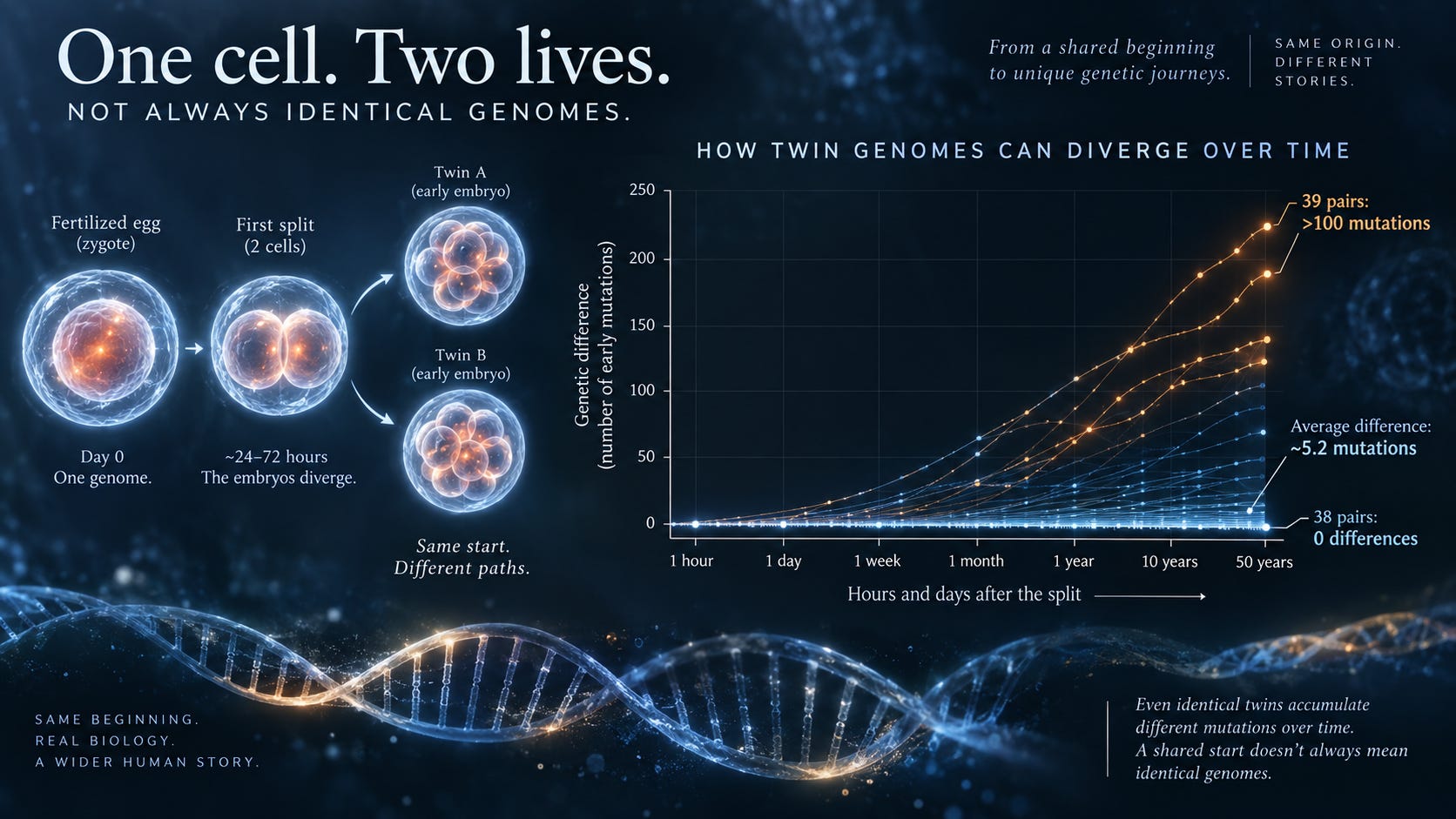
In 2021 a team at deCODE Genetics in Iceland sequenced 381 twin pairs and counted the mutations that arise in the first days after the egg splits, before the cells that will become eggs and sperm are set aside. Twins differ by 5.2 of them on average. Not 5.2 percent. Five or so individual letters of DNA, out of three billion.¹
The average is the least interesting number in that paper. The distribution is the story. 38 pairs differed by nothing at all. 39 pairs differed by more than 100 mutations.¹ Two people can begin as one cell and be born carrying different instructions, and how different depends largely on when the split happened and what went wrong in the hours around it.
The 5.2 is not a hard measurement but an inference rather than a direct count, worked backward from how many of those mutations the twins pass to their own children. The article’s authors are careful about this. But the conclusions are not in dispute, and neither is the consequence. Every twin study ever run assumed the pairs were genetically identical. Where that assumption fails, those studies have used environmental impacts as the culprit, building one sometimes incorrect assumption on another.¹
That is the small correction. Here is the large one.
Take the diseases we are most confident are genetic and look at what actually happens to the second twin. Schizophrenia is estimated to be about 79 percent inherited. When one twin is diagnosed as schizophrenic, the other has the same diagnosis 33 percent of the time.² Multiple sclerosis, 25 percent.³ Rheumatoid arthritis is even lower at around 15 percent, and the authors of that study went out of their way to note that the 30 percent figure everyone was quoting came from work three decades old that was simply wrong.⁴
These numbers may not mean what you may think. They do not mean the genes are unimportant. They mean that two people carrying an identical genetic loading for a disease will, most of the time, not both get it. The genome may make the disease possible, but something else decides whether it occurs.
And sometimes the something else is so simple its hard to believe. In 1986 physicians reported identical twin girls who were born to parents both whom carried HIV. One was born with the desease and got AIDS. The other, at 3 years old, was clinically, serologically and virologically normal.⁵ Same genome, same womb, same household. The difference was almost certainly nothing more than the order in which they were born and what each experienced on the way out.
Another study of interest in the 1950s: a large British survey of tuberculosis in twins concluded that susceptibility was inherited, and for decades that conclusion stood. In 2007 a team went back to the original records. Identical twins were indeed more often both infected than fraternal twins were, but when the researchers sorted the pairs by how infectious the person who exposed them had been, they determined it was likely not the genetics. What predicted a shared fate was shared exposure, not shared genes.⁶
Which seems obvious when you think about it, especially with a disease as infectious as TB. Identical twins do not only share a genome. They share a bed, a house, a school, a plate and a great deal of air. Any study that treats them as a controlled experiment is treating proximity as if it were biology.
So where does the difference live?
For twenty years the fashionable answer was epigenetics. Genes can be switched on and off without the code itself changing, and a 2005 study found that identical twins begin life with those switches set almost the same and drift apart as they age, fastest in the pairs who spend the least of their lives together.⁷ It is a real effect. It is also smaller than the coverage suggested, and some of what turns up in a sick twin is the mark left by the treatment rather than the cause of the disease.
My book reaches for the answer the evidence has been drifting toward.
You are carrying several pounds of other organisms, and that community is barely inherited at all. Somewhere between 2 and 8 percent of it tracks your genes. Strangers who share a kitchen have more similar gut flora than relatives who have never lived together.⁸ Identical twins are hardly more alike in this than fraternal twins.⁹
So here is a thing about you that is as consequential as your genome, that no two people share, and that identical twins do not share either.
And it decides who gets sick.
Clostridioides difficile is a common hospital infection that cannot easily take hold in a healthy gut, because the bacteria already living there change the chemical signal its spores need in order to wake up.¹⁰ Give a person antibiotics, kill those bacteria, and the gut flips to the setting the pathogen has been waiting for. The genome has not changed. The ecology has.
Which is why the treatment that works best is not a drug. In a trial stopped early because the result was so lopsided, transplanting a healthy donor’s gut flora cured 81 percent of patients after a single infusion, against 31 percent for the standard antibiotic.¹¹
You do not defeat the organism. You restore the neighborhood that was keeping it out.
That is the answer Elka arrives at in The Change. The thing out of the river cannot live in a person on its own. It needs a partner already present in the body, ordinary and unremarkable and easy to find once you know to look for it. Where the partner is, it takes root. Where the partner is not, it passes through and touches nothing. So she stops hunting the thing that is killing people and goes after what it requires.
In the end biology is not what the chapter is about.
Mina and Anke Orsgarden were born four minutes apart in a tall cold house in Hamburg. As children they had a game they never named, because it had only two players in all the world who could play it. One would hum a few bars of a tune she was inventing as she went, never a real song, never anything they both already knew, and stop dead on a note that led nowhere. The other had to hum the ending. Not the right ending, because there was no right one written down anywhere except in the head of the girl who had started it. What unsettled the adults who overheard it was how it never sounded wrong.
The Change took one of them and left the other. The true answer to why, still years away when it happened, was the unglamorous one: dose and chance and the hidden ecology of a body that even identical twins do not share.
It would not have comforted them to know why.
References
Jonsson H, Magnusdottir E, Eggertsson HP, et al. “Differences between germline genomes of monozygotic twins.” Nature Genetics 2021;53(1):27–34. doi:10.1038/s41588-020-00755-1
Hilker R, Helenius D, Fagerlund B, et al. “Heritability of Schizophrenia and Schizophrenia Spectrum Based on the Nationwide Danish Twin Register.” Biological Psychiatry 2018;83(6):492–498. doi:10.1016/j.biopsych.2017.08.017. Figures are probandwise concordance; heritability estimated at 79 percent.
Willer CJ, Dyment DA, Risch NJ, Sadovnick AD, Ebers GC. “Twin concordance and sibling recurrence rates in multiple sclerosis.” PNAS 2003;100(22):12877–12882. doi:10.1073/pnas.1932604100. Probandwise concordance 25.3 percent; the figure is higher in female pairs and lower in Italian cohorts, where it tracks local prevalence.
Silman AJ, MacGregor AJ, Thomson W, et al. “Twin concordance rates for rheumatoid arthritis: results from a nationwide study.” British Journal of Rheumatology 1993;32(10):903–907. doi:10.1093/rheumatology/32.10.903
Menez-Bautista R, Fikrig SM, Pahwa S, Sarangadharan MG, Stoneburner RL. “Monozygotic twins discordant for the acquired immunodeficiency syndrome.” American Journal of Diseases of Children 1986;140(7):678–679. doi:10.1001/archpedi.1986.02140210076029
van der Eijk EA, van de Vosse E, Vandenbroucke JP, van Dissel JT. “Heredity versus environment in tuberculosis in twins: the 1950s United Kingdom Prophit Survey Simonds and Comstock revisited.” American Journal of Respiratory and Critical Care Medicine 2007;176(12):1281–1288. doi:10.1164/rccm.200703-435OC
Fraga MF, Ballestar E, Paz MF, et al. “Epigenetic differences arise during the lifetime of monozygotic twins.” PNAS 2005;102(30):10604–10609. doi:10.1073/pnas.0500398102. Cohort was 80 individuals, that is 40 pairs; secondary sources frequently misreport this as 80 pairs.
Rothschild D, Weissbrod O, Barkan E, et al. “Environment dominates over host genetics in shaping human gut microbiota.” Nature 2018;555(7695):210–215. doi:10.1038/nature25973. The authors give 1.9 percent as a lower bound and 8.1 percent as an upper bound, and call for larger studies.
Goodrich JK, Waters JL, Poole AC, et al. “Human genetics shape the gut microbiome.” Cell 2014;159(4):789–799. doi:10.1016/j.cell.2014.09.053. The identical-versus-fraternal difference is significant on unweighted UniFrac (p = 0.032) but not on abundance-weighted measures.
Buffie CG, Bucci V, Stein RR, et al. “Precision microbiome reconstitution restores bile acid mediated resistance to Clostridium difficile.” Nature 2015;517(7533):205–208. doi:10.1038/nature13828
van Nood E, Vrieze A, Nieuwdorp M, et al. “Duodenal infusion of donor feces for recurrent Clostridium difficile.” New England Journal of Medicine 2013;368(5):407–415. doi:10.1056/NEJMoa1205037. 13 of 16 patients resolved after the first infusion, 15 of 16 including a second; 4 of 13 on vancomycin alone.
Diamond M, Sigmundson HK. “Sex Reassignment at Birth: Long-term Review and Clinical Implications.” Archives of Pediatrics & Adolescent Medicine 1997;151(3):298–304. doi:10.1001/archpedi.1997.02170400084015
The Change is out on October 1.