Ayahuasca - Two plants that are nothing apart
From the book The Change available for Pre-Order Now.
It takes two days to make this medicine.
Cut a woody vine and pound it soft. Pick the small bright leaves of a particular shrub one at a time, never stripping the branch, taking only a few. Then cook the two of them down through a day and a night into a thick dark liquid that smells of damp soil, rotting wood and smoke.
Alone, each ingredient does nothing at all. The vine will not open the doors of your mind. The leaf will not show you what lies behind them.
This recipe drives a key scene in my novel, and an epiphany that holds up the spine of the whole book. It also happens to be a reasonably accurate summary of a pharmacological process that Western science did not work out until the second half of the twentieth century, and that the people of the Ucayali have been using for a great deal longer.
Start with what is actually in the cup, because the chemistry here is genuinely elegant.
The leaf is chacruna, Psychotria viridis. It contains DMT, a powerful psychoactive compound that does nothing whatsoever if you swallow it. Not a weak effect, not a mild one. Nothing, beyond an unhappy stomach if you are determined about it. An enzyme in your gut wall called monoamine oxidase A destroys the molecule before it reaches your bloodstream, which is more or less what that enzyme is there for.¹
The vine is Banisteriopsis caapi. It contains harmine, harmaline and tetrahydroharmine, which are inhibitors of that exact enzyme.¹ On its own the vine is emetic and purgative and, by most accounts, mildly visionary, but it is not what produces the experience people cross the world for.
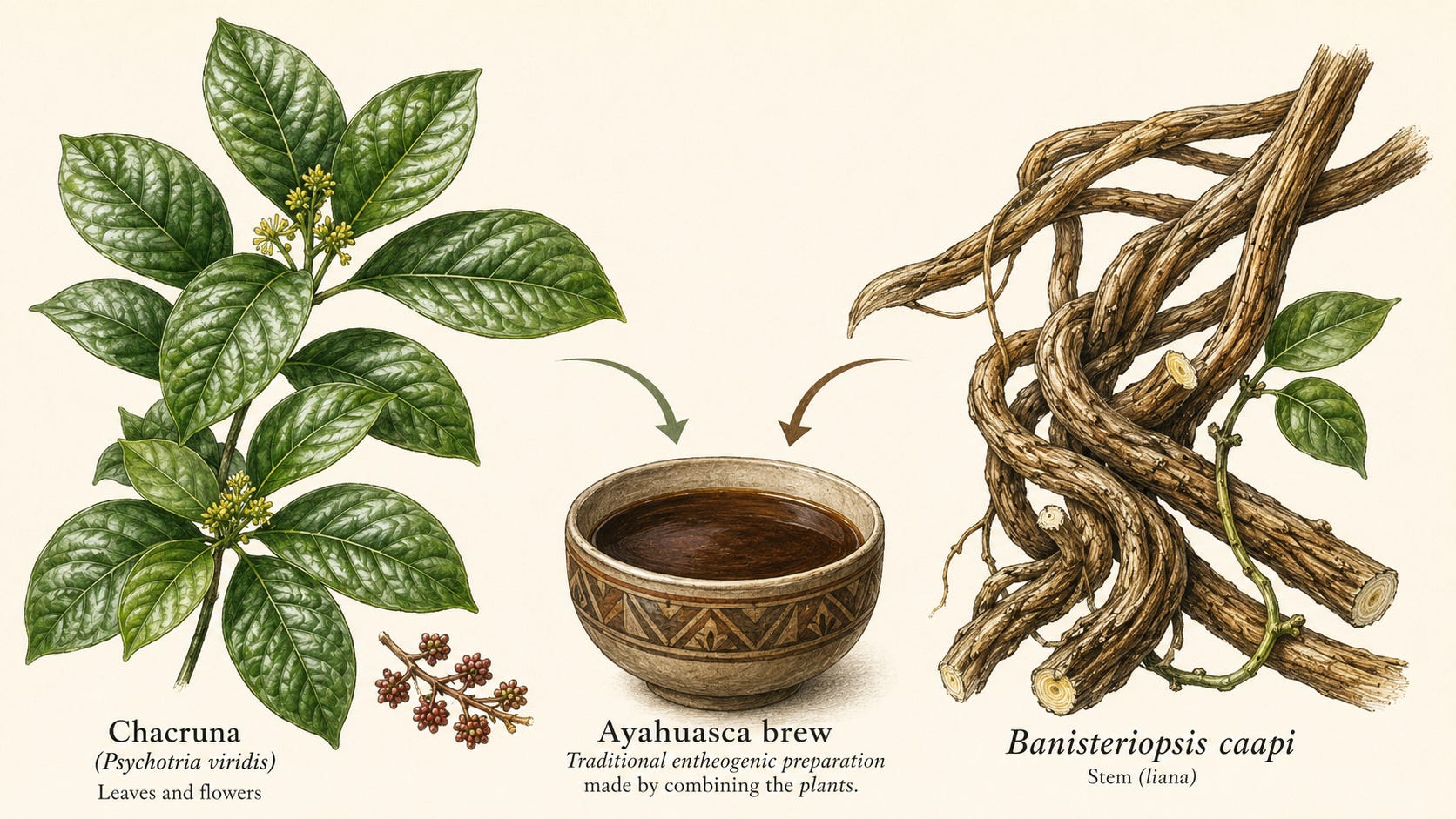
Put the two together and the alkaloids in the vine stand down the enzyme in your gut, the leaf’s DMT survives the journey, and a compound that is inert by mouth becomes powerfully active.
It is the difference between shouting louder and opening a window. The vine does not raise the voice. It removes the wall.
That principle now has a name in pharmacology and a whole class of drugs built on it. In the Amazon it has a recipe.
The ceremony matters here more than the chemistry, and it is the part outsiders consistently get wrong.
Among the Shipibo-Konibo of the Ucayali, the person who prepares and runs it is the onaya, which translates roughly as one who knows.³ The whole tradition treats the brew as access to knowledge rather than as an experience, and the healer’s authority comes from having had occasion to access knowledge, often, and remembered the way. If you read Chapter One of The Change, this is what I am describing without ever using its name.
The brew is a violent purgative, and this is not a side effect politely tolerated but, instead an expected part of the experience. Nobody apologizes to you for vomiting. You are expected to, and it is understood as the medicine doing what medicine does. My novel has a young man told exactly this before he drinks: that it is a poison which does not kill, and that giving it back is part of how it works.
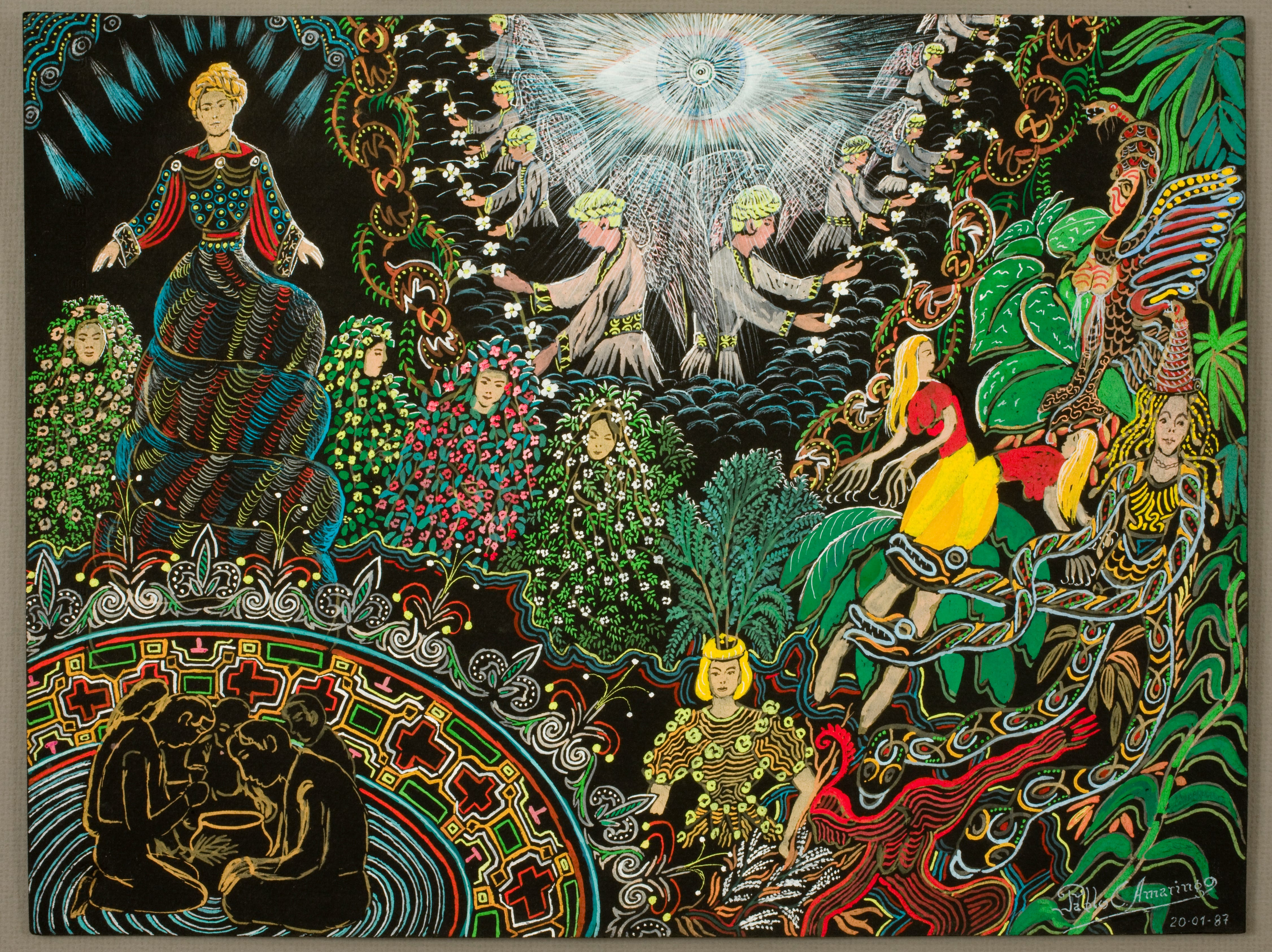
And through all of it the onaya sings. The songs are ícaros, a word that comes into Spanish from Quechua, from a verb meaning to blow smoke in order to heal.⁴ They are sung, chanted, whistled or hummed, often over the shake of a bundle of leaves, and they are learned through lineage and through long dietary and social restriction rather than taught in an afternoon. Ethnographically, what the ícaros are agreed to do is functional. They call, they structure the phases of the night, they protect, and they steer the intensity and direction of what is happening to the person lying on the floor.
In my book I describe them as maps, paths the singer has already walked, sung out loud so the ones who drank can follow and not be lost. I want to be straight that this is my image and not an ethnographic finding. There is a real scholarly argument that some of the more mystical framings of Shipibo song, particularly the idea that the singer is singing a visual design, were introduced by visiting anthropologists and then adopted back.⁵ I used the metaphor because it is true to how the practice functions. I am not going to dress it up as something the Shipibo told me.
One more thing worth saying, since my novel borrows from these people. The Shipibo-Konibo are not a historical curiosity. There are roughly 33,000 of them living on the Ucayali and its tributaries right now.⁶ The Shetebo, whom I also fictionalized, are one of the three groups that merged to form them.⁶ I moved a single letter in each name so a reader would hear the echo and go looking for the real thing.
Now the fun question. Who came up with this and why?
I wonder about this constantly when I read deep history, whenever two things turn out to belong together for reasons nobody could have predicted. Why would anyone ever think to put those two things in the same pot and cook it for a day and a half?
The best naturalistic explanation I found belongs to Steve Beyer, and I like it because it is deflating in exactly the right way. His suggestion is that people were not looking for visions at all. They were looking for a better way to vomit.⁸
Emetics and purgatives are used heavily across Upper Amazon medicine. The caapi vine is a powerful one. And chacruna belongs to the genus Psychotria, which also gave the world ipecac, the classic emetic in every old medicine cabinet. Combine plants inside a coherent functional class, to strengthen or modulate a purge, and the visionary effect arrives as a byproduct nobody was hunting.⁸
It is a hypothesis. It has not been tested and may never be. Beyer’s own summary of the origin question is the most honest sentence in the literature: “I have the answer to these questions. We do not know”.⁸
Even the age is contested. There is a ritual bundle from a Bolivian rock shelter, dated to around 1,000 CE, that contained both harmine and DMT, the two key alkaloid classes in one kit.⁹ But a serious body of scholarship argues the oral brew as we know it may be far younger than the romantic version, perhaps only 17th or 18th century, spread along the rivers through Jesuit mission settlements.¹⁰ The linguistic evidence is uncomfortable for the ancient reading. The technical vocabulary of ayahuasca shamanism across many unrelated languages is contemporary Quechua, and among the Shipibo the ícaros are the only songs not sung in Shipibo.¹⁰
I do not know who is right. Neither, at present, does anyone.
Here is why the ceremony is so key to the spine of my novel.
My scientist, Elka, spends two years hunting a single organism. It is ancient, it is very good at not being found, and she cannot kill what she cannot locate. She is exhausted and she is stuck. She is stuck in a way that often happens with diligent scientists. She is asking a well thought out set of questions that happen to be the wrong ones.
What breaks it is not a laboratory result. It is the ceremony, described to her by a man beside a fire, surfacing in a dream. The vine and the leaf. Alone, each is nothing.
And she understands that the thing in the river is also two things, and that the reason one twin changed and the other did not was never written in their blood. The old organism cannot live in a person by itself. It needs a partner already present in the body, ordinary and unremarkable and easy to find once you know to look. Where the partner is, it takes root. Where the partner is not, it passes through and touches nothing.
So she stops hunting the pathogen. She goes after its companion instead.
It was never two problems. It was one lock and one key, and the map to it was a ceremony older than her science, waiting for her to recognize it.
That is the same logical move the brew makes. You do not defeat the thing. You remove what the thing requires.
My method in this book was to explain the ingredients and never explain the reaction. Research the real components until they are true, then let the impossible part fly unexplained.
Ayahuasca is the reason I trust that method. Here is a preparation whose pharmacology we can now describe down to the enzyme, and whose discovery we cannot explain at all. The mechanism is solved. The origin is not.
Which is roughly where every good story about knowledge ends up, and it is worth remembering the next time someone tells you a traditional practice is merely superstition, or that it is ancient wisdom beyond the reach of science. It is usually neither. It is people paying very close attention to one place over a very long time, and arriving somewhere the rest of us took centuries to reach by another road if at all.
The Change is out on October 1.
References
Egger K, Aicher H, Cumming P, Scheidegger M. Neurobiological research on N,N-dimethyltryptamine (DMT) and its potentiation by monoamine oxidase (MAO) inhibition: from ayahuasca to synthetic combinations of DMT and MAO inhibitors. Cell Mol Life Sci. 2024;81(1):395. doi:10.1007/s00018-024-05353-6. Harmine and the related β-carbolines are reversible MAO-A inhibitors, and MAO-A in the gastrointestinal tract is the principal determinant of oral DMT bioavailability.
The Great Red Dragon paintings are dated c. 1805–1810; William Blake died in 1827. Richard Spruce collected the first scientific specimens of Banisteriopsis caapi on the Rio Uaupés in November 1852 and published his account in Notes of a Botanist on the Amazon and Andes (1873).
Aronovich A, Labate BC. On the onaya and Shipibo healing practice, in Labate BC, Cavnar C (eds), Ayahuasca Healing and Science. Springer, 2021.
Luna LE. Vegetalismo: Shamanism Among the Mestizo Population of the Peruvian Amazon. Stockholm Studies in Comparative Religion, 1986. See also Beyer SV, Singing to the Plants. University of New Mexico Press, 2010.
Brabec de Mori B. “Song Patterns and Sung Designs: the Invention of Tradition among Amazonian Indians as a Response to Researchers’ Inquiries,” in Richter P (ed), Musical Traditions. Budapest, 2012. See also Brabec de Mori B, Mori Silvano de Brabec L. “Shipibo-Konibo Art and Healing Concepts: A Critical View on the ‘Aesthetic Therapy’.” Viennese Ethnomedicine Newsletter. 2009;11(2–3):18–26.
Ministerio de Cultura del Perú, Base de Datos de Pueblos Indígenas u Originarios: Shipibo-Konibo. https://bdpi.cultura.gob.pe/pueblos/shipibo-konibo. The 2017 national census recorded 34,152 people with Shipibo-Konibo as mother tongue; the Ministry estimates 32,964 living in Shipibo-Konibo communities. The people formed from the merger of three previously distinct groups: the Shipibo, the Konibo and the Shetebo.
Cardoso D, Särkinen T, Alexander S, et al. Amazon plant diversity revealed by a taxonomically verified species list. PNAS. 2017;114(40):10695–10700. PMID 28923966.
Beyer SV. “On the Origins of Ayahuasca.” Singing to the Plants, 2012. https://singingtotheplants.com/2012/04/on-origins-of-ayahuasca/
Miller MJ, Albarracin-Jordan J, Moore C, Capriles JM. Chemical evidence for the use of multiple psychotropic plants in a 1,000-year-old ritual bundle from South America. PNAS. 2019;116(23):11207–11212. PMID 31061128.
Gow P. “River People: Shamanism and History in Western Amazonia” (1996), and Brabec de Mori B, “Tracing Hallucinations: Contributing to a Critical Ethnohistory of Ayahuasca Usage in the Peruvian Amazon,” in Labate BC, Jungaberle H (eds), The Internationalization of Ayahuasca. LIT Verlag, 2011:23–47. For the contrary view, see Luna LE (2011), who considers a purely recent origin unlikely.